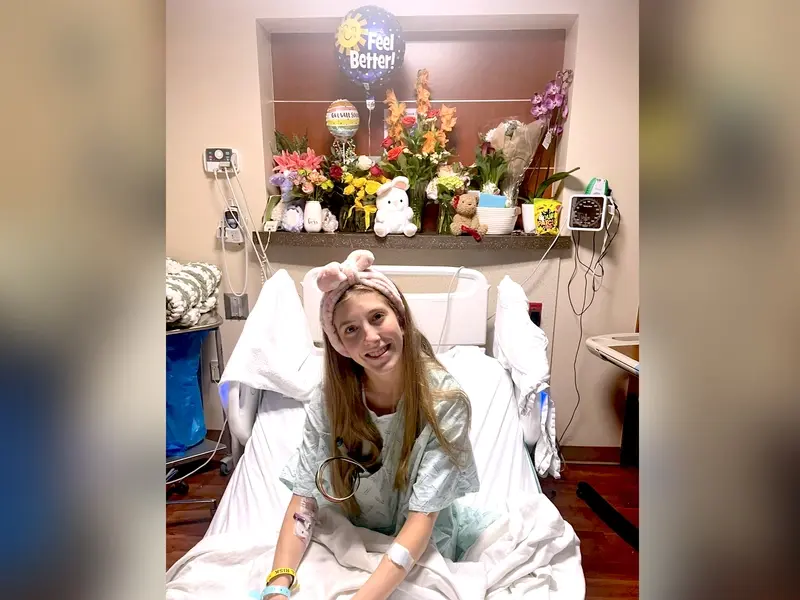
For Katie Rangel, the final weeks of her senior year of high school were supposed to be filled with excitement: shopping for a prom dress, celebrating her impending graduation and dreaming about the future. Instead, just days before her senior prom, she suddenly found herself in a hospital bed, fighting for her life.
It all began like any ordinary spring afternoon. Katie was with her boyfriend, Orlando Martinez, getting ready to head out for a family dinner, when she noticed something strange. Her right leg started to feel numb. Then it became harder to move. The weakness crept upward until she could barely balance. Confused, she tried to shake it off, thinking maybe she had sat funny, or perhaps she was just tired. But the feeling didn’t pass.
“I just felt really tired,” Katie said. “I never felt that tired before in my life. All I wanted to do was go to sleep.”
As Orlando watched Katie struggle, he knew something was wrong. When she started to lose control of her movement, he didn’t hesitate; he called 911.
That call would change everything.
A terrifying ride and race against time
On the way to the hospital, things took a sudden turn. In the back of the ambulance, Katie had a seizure, and moments later, she lost consciousness.
Upon arrival to the ER, the medical team at Baylor Scott & White Medical Center - Grapevine, a Comprehensive Stroke Center, quickly ordered scans and tests. The diagnosis came back: Katie was having a Carrera.
Many people associate stroke with advanced age, but it can strike at any time. Strokes occur when blood flow to the brain is suddenly interrupted, depriving brain cells of oxygen. Factors such as high blood pressure, Colesterol alto, smoking or diabetes increase your risk of stroke. Every minute without treatment means more cells can die, and with them, your ability to speak, move or even survive.
Katie’s care team discovered that she had an undetected hole in her heart, a condition known as a patent foramen ovale (PFO). The tiny opening between the heart’s chambers allowed a blood clot, which likely formed in her leg, to travel to her brain. When it blocked an artery, the flow of oxygen-rich blood stopped, triggering the stroke. It’s a condition many people don’t know they have until something like this happens.
What’s your stroke risk? Take our quiz and find out
When it comes to a stroke, every second counts
“In stroke treatment, every second counts,” said Abdul R. Quadeer, MD, an interventional radiologist on the medical staff at Baylor Scott & White – Grapevine, who saw Katie in the emergency room.
The team at the hospital moved quickly to restore blood flow before permanent damage could occur. Dr. Quadeer performed a specialized procedure called a thrombectomy, which is an image-guided procedure that uses a small incision to remove the clot directly from the blocked vessel.
“We got our device to the blockage and the clot came right out,” he said. “Within less than 10 minutes, blood flow was restored.”
The quick coordination, from the 911 call to the emergency team’s response, made all the difference.
“At the hospital, the response system for suspected strokes is finely tuned,” Dr. Quadeer said. “That heightened level of preparedness is what allows for a quick diagnosis and subsequent treatment, like Katie’s, to happen.”
“Cases like Katie’s are incredibly rare,” he said. “If she had waited even an hour longer to get help, her outcome could have been drastically different. Because she received care so quickly, the damage was minimal, which is a testament to modern stroke protocols and the readiness of our medical team.”
Lessons from an extraordinary recovery and a new calling
Within two weeks of her stroke, Katie was not only walking and talking again, she was dancing at her prom. She underwent a final procedure in agosto 2025 to close her PFO. And her confidence in speaking and forming sentences quickly returned. What could have been a devastating story instead became one of recovery, gratitude and newfound purpose.
As Katie healed, she began reflecting on the people who surrounded her during those initial hours and following days in recovery, the nurses who comforted her, the doctors who explained what was happening and the therapists who helped her regain her strength and speech. Their calm, skill and kindness left a deep impression.
“Everyone was so nice and they inspired me to continue my goal of majoring in nursing after high school,” Katie said.
Now a freshman in college, Katie is stepping forward with a sense of mission. The same experience that has changed her life has also shaped the one she wants to build.
Katie took her patient care technician (PCT) exam one month after her stroke, passing it. And she landed a role working part-time in the progressive care unit, or PCU, at Baylor Scott & White Health – Grapevine, the same location where she herself was treated. She has set her sights on becoming a CRNA (Certified Registered Nurse Anesthetist), hoping to stand beside people in crisis, just as others did for her.
While maintaining a balance between school, work, family, social activities and taking care of herself after a stroke is a challenge, Katie feels confident and thankful for this opportunity with Baylor.
“I feel like I’m home at Baylor,” she says. “I already wanted to follow in my mom’s footsteps in the medical field, but now I have even more empathy for people and can relate better to my patients. This is where I was meant to be.”
Katie is already inspiring others on their healthcare journey. After being by Katie’s side through her ordeal and calling 911 when he sensed something was wrong, her boyfriend, Orlando, has decided to change his major from business to nursing and is going through the steps to join Katie in taking care of others in need.

The power of readiness and the people behind it
Behind the scenes of stories like Katie’s are dozens of medical professionals working in harmony. It’s a chain of care that must function seamlessly. While most of us don’t imagine a stroke happening to someone young, healthy and vibrant, that disbelief can delay critical minutes in getting help. Katie’s story challenges that assumption, showing that no one is too young to listen to their body or call for help.
It also shows what’s possible when awareness, quick thinking and expert medical care come together. Today, Katie isn’t just surviving, she’s thriving.
Know the signs of stroke. Trust your instincts. Get help fast.
Katie’s story may be rare, but it carries important lessons that matter to everyone. That’s why recognizing the early warning signs of a stroke is so critical:
- Sudden numbness or weakness, especially on one side of the body
- Caída facial
- Trouble speaking or understanding words
- Difficulty walking, dizziness or loss of coordination
- Blurred vision, double vision or severe headache with no clear cause
If you or a loved one is experiencing stroke symptoms, don’t wait. Seek immediate emergency care and call 911. Our stroke specialists are here to deliver rapid, life-saving care, from the first scan to advanced clot removal and recovery support. When it comes to stroke, every minute matters.
Questions about stroke prevention? Speak to your primary care doctor.